Saturday, December 21, 2019

Best of the Decade (2010s): Podcasts

The 2010s was a big decade for podcasts. Though I started listening to a few before 2010, the became a larger part of my life and commute this decade. See below for my favorite podcasts of the decade (grouped by five categories: Current Happenings, Series, Interviews, Stories, Topical):

Current Happenings
Podcasts where episodes come out 2-3 times a week and mostly contain conversations about topics of the day.

The Bill Simmons Podcast
This has been a staple for me over the last 5-6 years. I love sports and this is the main way that I stay up to date on what’s going on. Bill is interacts with various guests, mostly to discuss interesting happenings in sports, but sometimes to discuss pop culture, movies, etc.

The Relevant Podcast
This has been one of my favorite and most consistent podcasts over the last 12 years (started in 2007). Episodes come out twice a week and mostly consist of hilarious banter about random things, faith-meets-culture updates, and interviews with various leaders/songwriters/authors.


Series
Podcasts telling one story over multiple episodes.

Serial (Season 1 - 2014) - This was an incredible journalistic story that seemed to have most of the country captivated during its run and seemed to re-invigorate the true crime genre. This American Life producer, Sarah Koenig, took another look at a murder case from 1999 involving Adnan Syed.

Scene on the Radio: Seeing White (2017) - I was really challenged by and appreciated this series on race and whiteness.

S-Town (2017) - This is the fascinating account of John B. McLemore, genius and antique clock restorer, troubled by his own self, his small Alabama town and so many things in the world. Great story-telling by Brian Reed about a very unique man. 

Blue Babies Pink (2016) - I was really challenged by listening to this story of Brett Trapp, growing up as a Christian and struggling with his sexuality. It help create a lot more empathy and understanding for those who are gay.

74 Seconds (2017) - This tells the tragic story of the shooting of Philando Castile, during a July 2016 traffic stop outside of Minneapolis. It took 74 seconds from the stop to the shooting. This podcast explores race, policing, justice and safety in America.

Caliphate (2018) - A New York Times reporter goes on a quest to better understand ISIS. It’s fascinating to hear her get to know former members as they explain more about the organization and how they got there.

On the Media: Busted: America’s Poverty Myths #1 - #5 (1/17/16) - A very challenging and interesting series that speak to our incorrect assumptions about poverty.

Dolly Parton’s America (2019) - RadioLab host Jad Abumrad helps us understand Dolly’s past, influence, and her place in the “crossroads of America’s culture wars.


Interviews
Podcasts where each episode is a different interview.

On Being
I discovered this podcast earlier this year, but it’s quickly risen to one of my favorites. Host Krista Tippett thoughtfully engages with each guest, always asking insightful questions, ultimately trying to open up conversations around deep realities of meaning and purpose. 

Favorite Episodes:
  • Eugene Peterson (12/22/16)
  • Ta-Nehisi Coates: Imagining a New America (9/12/19)
  • Father Gregory Boyle (2/26/13)
  • Isabel Wilkerson - The Heart Is The Last Frontier (01/11/18)

Conversing
Hosted by Fuller Seminary president Mark Labberton. I appreciate the focus on issues like community, justice, creativity, and faith.

Favorite Episodes:
  • Tony Hale on the Creative Life  (6/25/19)
  • David Brooks and Community (4/9/19)
  • Gary Haugen on Working with the Poor (2/27/18)

WTF with Marc Maron
On each episode, comedian Marc Maron interviews a different guest, often from Hollywood, about their personal stories. Marc is very open about his own struggles and does a great job connecting with his guests and having them open up about the experiences that have shaped their lives.

Favorite Episodes:
  • BrenĂ© Brown (4/22/19)
  • President Barack Obama (6/22/15)

Stories
Podcasts where each episode is a different story or a collection of stories.

This American Life
I started listening in 2011 and have tuned in most every week since then. It’s produced and hosted by Ira Glass and puts on weekly episodes centered around a particular topic. 

Favorite Episodes:
  • White Haze (9/17/17)
  • 129 Cars (11/16/19)
  • Beware the Jabberwock (3/17/19)

RadioLab
I started listening to this back in 2014. Hosts Jad Abumrad and Robert Krulwich do a great job unpacking various stories related to science, philosophy, psychology, and history.

Favorite Episodes:
  • Match Made in Marrow (11/9/17)
  • For the Love of Numbers (5/2/14)
  • Oliver Sipple (9/22/17)

Topical
Podcasts where each episode or season is a discussion on a particular topic or idea.

This Cultural Moment
Having just ended its third season, this is self-described as a podcast about following Jesus in the post-Christian world. Each episode is a collaborative conversation, mostly between John Mark Comer and Mark Sayers, about our current post-Christian age. Very engaging and insightful. 

Favorite Episodes:
  • Live at Wildfires in the UK (6/11/19)
  • Soft Power, Dirty War, and Russian YouTube Videos (12/4/18).

The Liturgists Podcast
I don’t currently subscribe to this one and haven’t always jived with the conversations had here, but they have produced some very helpful/impactful episodes related to various topics. 

Favorite Episodes:

  • LGBTQ (5/19/15)
  • Black and White: Racism in America (5/19/16)
  • Christian Violence (6/6/17) 

Monday, December 16, 2019

Best of the Decade (2010s): Concerts

Here are my favorite concerts of the decade:
  1. Mumford & Sons at Buckhead Theatre (Atlanta) - November 7, 2010
  2. Jonsi at The Tabernacle (Atlanta) - October 31, 2010
  3. Sufjan Stevens at Cobb Energy Theatre (Atlanta) - November 5, 2015
  4. Lone Bellow at Eddie’s Attic (Decatur) - April 3, 2013
  5. Kings Kaleidoscope at The Loft (Atlanta) - April 26, 2019
  6. Sufjan Stevens at The Tabernacle (Atlanta) - November 6, 2010
  7. John Mayer at Lakewood Amphitheater (Atlanta) - September 8, 2010
  8. Mumford & Sons at Red Rocks Ampitheatre (Denver) - August 29, 2012
  9. Johnnyswim at The Roxy Theatre (Atlanta) - May 11, 2019
  10. Patty Griffin at Red Clay Theatre (Duluth) - October 12, 2012
  11. Arcade Fire at Verizon Wireless (Alpharetta) - August 11, 2010
  12. Matthew Perryman Jones at Red Clay Theater (Duluth) - October 26, 2012
  13. Avett Brothers at Verizon Wireless (Alpharetta) - May 17, 2013
  14. Garth Brooks at Philips Arena (Atlanta) - September 20, 2014
  15. Over the Rhine at Eddie’s Attic (Decatur) - March 8, 2010
  16. Jump Little Children at Variety Playhouse (Atlanta) - September 21, 2019
  17. Civil Wars at El Rey Theatre (Los Angeles) - June 15, 2011
  18. Johnnyswim at Variety Playhouse (Atlanta) - September 26, 2014
  19. Rosie Thomas at Hotel Cafe (Los Angeles) - April 29, 2012
  20. Switchfoot at The Wiltern (Los Angeles) - October 11, 2011
  21. Ben Rector at The Tabernacle (Atlanta) - October 18, 2013
  22. Avett Brothers at Chastain Amphitheater (Atlanta) - September 10, 2010
  23. William Fitzsimmons at Smith’s Old Bar (Atlanta) - July 23, 2010
  24. Lone Bellow at Terminal West (Atlanta) - October 22, 2013
  25. Tyrone Wells at Hotel Cafe (Los Angeles) - October 30, 2011 

Sunday, December 15, 2019

Best of the Decade (2010s): Albums & Songs

As we come to the end of another decade, I've been reflecting on some of my favorite media/art that I've taken in and enjoyed. Over the next few weeks, I'll be sharing some of these lists.

Like most of the other lists to come, it's difficult for me to pick clear winners in each category. I like to think of this and upcoming lists as  compilations of my favorites, where generally, the higher the more I have or still do appreciate it, but many could be switched around based on mood.

First up is a list of my favorite albums and songs of the decade. Music has always been really important to me. I love how it calls out things that are true and we can make deep connections with it. I also love it because it can provide soundtracks for times of joy and dance, but also for grief and reflection.

These songs and the below albums have been my soundtrack to this past decade.

  1. Kings Kaleidoscope - Beyond Control (2016)
  2. Matthew Perryman Jones - Land of the Living (2012)
  3. Sufjan Stevens - Carrie & Lowell (2015)
  4. The Modern Post - The Water & The Blood (2013)
  5. Mumford & Sons - Sigh No More (2010)
  6. Manchester Orchestra - A Black Mile to the Surface (2017)
  7. The Lone Bellow - The Lone Bellow (2013)
  8. Kings Kaleidoscope - Zeal (2019)
  9. Vampire Weekend - Modern Vampires of the City (2013)
  10. Kacey Musgraves - Golden Hour (2018)
  11. Kings Kaleidoscope - Becoming Who We Are (2014)
  12. Vampire Weekend - Father of the Bride (2019)
  13. Switchfoot - Vice Verses (2011)
  14. JOHNNYSWIM - Moonlight (2019)
  15. Arcade Fire - The Suburbs (2010)
  16. Jonsi - Go (2010)
  17. Kanye West - My Beautiful Dark Twisted Fantasy (2010)
  18. Ben Howard - Every Kingdom (2011)
  19. Kings Kaleidoscope - The Beauty Between (2017)
  20. Derek Webb - I Was Wrong, I’m Sorry & I Love You (2013)
  21. Vampire Weekend - Contra (2010)
  22. Chance the Rapper - Coloring Book (2016)
  23. Kendrick Lamar - To Pimp A Butterfly (2015)
  24. The Lumineers - The Lumineers (2012)
  25. LANY - LANY (2017)
  26. John Mayer The Search For Everything (2017)
  27. Johnnyswim - Diamonds (2014)
  28. Lecrae - All Things Work Together (2017)
  29. Local Natives - Hummingbird (2013)
  30. Crowder - American Prodigal (2016)
  31. The Head and the Heart by The Head and the Heart (2010)
  32. High Violet by The National (2010)
  33. Bon Iver - Bon Iver (2011)
  34. The Lumineers - Cleopatra (2016)
  35. The Hurry and the Harm by City and Colour (2013)
  36. NF - Perception (2017)
  37. Justin Timberlake - The 20/20 Experience (Part 1) (2013)
  38. Lecrae - Rehab (2010)
  39. Avett Brothers - The Carpenter (2012)
  40. Fleurie - Love and War (2016) 

Sunday, December 30, 2018

Favorite Books I Read in 2018

Once again, I get to think through and post my favorite books I read this year. This continues to be a highlight of the year for me because I get to remember these books again and think through why I liked each of them. I also get to do one of the things I love most, recommend books!

Here are my favorite books that I read in 2018:

1. The Dark Tower series by Stephen King (1982 - 2012)

At the end of last year, I had never read a Stephen King book and had never heard of this series. However, after hearing multiple co-workers talk about how this series was one of their favorites, I took a chance and started reading. The series is made up of seven books, written between 1982 and 2004, and is a futuristic fantasy Western, centered on Roland Deschain of Gilead. King considers this his magnum opus and would say that most of his other works have bits of The Dark Tower in them. The Lord of the Rings and The Good, the Bad, and the Ugly are two of his main inspirations for the characters and plot.

The first book, The Gunslinger, was the shortest and my least favorite. Once I got a quarter of the way through book two, The Drawing of the Three, I was hooked. Book four, Wizard and the Glass, was probably my favorite, and the conclusion in the final book, The Dark Tower, was very well done. By the way, I recommend reading them in order, but reading Wind Through the Keyhole, which King wrote last, between books four and five. 

I really loved the story overall as it draws you in to a rag-tag group of people (known as "ka-tet") who, though hesitant at first, become united in their purpose and love for each other. Roland is a deeply flawed individual, but I love his strength and courage, his singular focus in life, and the ways he grows in his ability to love others. I'll miss the world that King created, but its characters and unique language will stay with me for a while. Long days and pleasant nights. 


This is an indispensable book for all parents who want to lead their families well in the 21st century. While Tony Reinke’s book (below) has more of a focus on phones and social media, Crouch’s focus is on the home and how we should more purposefully consider interacting with many different types of technology. His guiding principles (Ten Tech-Wise Commitments) are excellent. In them, he lays out what a family should be about (developing wisdom and courage, more creating than consuming) and then practical commitments in light of those. 

“Boredom -- for children and for adults -- is a perfectly modern condition. The technology that promises to release us from boredom is actually making it worse -- making us more prone to seek empty distractions than we have ever been...the more you entertain children, the more bored they will get...the videos we put on for our kids -- or the video games we pull up on our phones in our own moments of boredom -- are designed, unconsciously or consciously, to produce a bewitching effect. And this effect is achieved by filling a screen with a level of vividness and velocity that does not exist in the real world -- or only very rarely…So here is one result of our technology: we become people who desperately need entertainment and distraction because we have lost the world of meadows and meteors.”

3. 12 Ways Your Phone is Changing You by Tony Reinke (2017)

This was a very engaging, convicting, and helpful read about how our smart phones are changing the way we exist in the world. Reinke interacts with media theorists, psychologists, and everyday examples to point out the ways our phones are shaping us (causing us to be addicted to distraction, to crave immediate approval, to perpetuate our own loneliness, to lose our ability to think deeply, to fear missing out) and that what our hearts are really longing for underneath the constant interaction with our phones (connection with God and others). This book is great because it helps you see the silliness (at best) and destructiveness (at worst) behind our habits, gives some practical tips for using your phone in a healthy way, and also provides great wisdom behind those tips so that there might be lasting change. 

“...we must become mindful and slow our pace...'The more we take refuge in distraction, the more habituated we become to mere stimulation and the more desensitized to delight. We lose our capacity to stop and ponder something deeply, to admire something beautiful for its own sake’ (Brad Littlejohn)...By seeking trivial pleasure in our phones, we train ourselves to want more of those trivial pleasures. Most seriously of all, ‘either we, out of fear and guilt, lose our delight in God, the source of all good, and thus begin to lose our delight in all the goods he has given us.'"

4. Seeking Allah, Finding Jesus: A Devout Muslim Encounters Christianity by Nabeel Qareshi (2016)

This was a very moving story and a very fascinating read. Qareshi spends a good bit of the book reflecting upon and describing how practices of Islam were meaningful and impactful to him, offering a perspective I had not learned much about before. He also shows how he wrestles with his faith with his good friend, David. Through many disagreements and openly talking about their worldviews, Qareshi begins to see how much of Islam’s belief system and the Quran itself is blindly accepted with little critique, while the Bible and the person of Jesus seem to stand up in the face of much scrutiny. Living in the United States, and especially the South, I don’t have to give up much to be a Christian. It’s humbling and challenging to read about how much Qareshi gives up to follow Jesus.

“While I was wallowing in self-pity, focused on myself, there was a whole world with literally billions of people who had no idea who God is, how amazing He is, and the wonders He has done for us. They are the ones who are really suffering. They don’t know His hope, His peace, and His love that transcends all understanding. They don’t know the message of the gospel. After loving us with the most humble life and the most horrific death, Jesus told us, 'As I have loved you, go and love one another.' How could I consider myself a follower of Jesus if I was not willing to live as He lived? To die as He died? To love the unloved and give hope to the hopeless?” 


Having been written eight years ago, there are parts of this book that seem dated, but overall, this is still a very relevant read in our age of distractedness. The premise is that our brains are literally re-wired by the Internet and other related technologies to become distracted and shallow thinkers in all areas of our lives. I like that the author leans heavily on McLuhan's Understanding Media and uses history to show how our technology tools have developed over time and both what was lost and gained with each major advancement. Spending less time on the Internet and associated technologies and spending more time in nature are two of the implicit take-aways that will help to build a calm, attentive mind, which can lead to deep thinking and empathy.

“...after spending time in a quiet rural setting, close to nature, people exhibit greater attentiveness, stronger memory, and generally improved cognition. Their brains become both calmer and sharper...when people aren’t being bombarded by external stimuli, their brains can, in effect, relax. They no longer have to tax their working memories by processing a stream of bottom-up distractions. The resulting state of contemplativeness strengthens their ability to control their mind.”

6. Ready Player One by Ernest Cline (2012)

At the recommendation of a friend, I was able to read this before seeing the movie that came out in the spring (side note: while the movie got some things right and was entertaining in its own way, the book was better, as per the norm). It was very entertaining and hard to put down. The story is all about a futuristic dystopia where most people spend their days plugged into a virtual reality game (OASIS). The protagonist, Wade Watts, ends up learning everything about 80s TV, movies, and video games to help him succeed in the game, so it’s fun to be taken back into that world a bit. It’s also interesting to see how the story is a commentary on how our current lives are more and more bound up in online and virtual relationships and games. It shows what this does to a person, and how connecting with people in the physical, actual world, is the best kind of connection. 

"I created the OASIS because I never felt at home in the real world. I didn't know how to connect with the people there. I was afraid, for all of my life, right up until I knew it was ending. That was when I realized, as terrifying and painful as reality can be, it's also the only place where you can find true happiness. Because reality is real."


In 2018, it seems that beliefs and ideas about the world are as divisive as ever. Most of us are very quick to mock those who disagree with us, instead of thoughtfully engaging in a dialogue that could possibly change our minds. In this book, Jacobs argues that most of us don’t really want to think, because thinking is hard, and it’s easier to say things that make you feel like part of the in-group. It’s easier to go into “Refutation Mode” and quickly dismiss what others say without considering that they could be right. Jacobs calls us to humility and courage as we do the hard work of considering those with different beliefs to be our neighbors and less as the "Repugnant Cultural Other."

“Everyone today seems to have an RCO [Repugnant Cultural Other], and everyone’s RCO is on social media somewhere...This is a profoundly unhealthy situation. It’s unhealthy because it prevents us from recognizing others as our neighbors -- even when they are quite literally our neighbors. If I’m consumed by this belief that that person over there is both Other and Repugnant, I may never discover that my favorite television program is also his favorite television program; that we like some of the same books...I may all to easily forget that political and social and religious differences are not the whole of human experience. The cold divisive logic of the RCO impoverishes us, all of us, and brings us closer to that primitive state that the political philosopher Thomas Hobbes called ‘the war of every man against every man.’”

8. The Denial of Death by Ernest Becker (1973)

I first heard of this book in 2011, as it was assigned as reading for my seminary class Grief, Loss, Death and Dying. However, it took several more years, seeing it as influential to many and this great blog post interaction with it, to finally tip the scales for me to read it. While it was not a light read and one that was dense at times, I’m very glad I made it through. Becker’s argument in this book, for which he won a Pulitzer Prize in 1974, is that h
uman civilization is ultimately an elaborate, symbolic defense mechanism against the knowledge of our mortality and that death is man’s greatest anxiety. Because of this anxiety, we either focus on the small problems of our lives and “tranquilize ourselves with the trivial,” or we seek to transcend death by trying to live lives full of meaning, believing them to live on through eternity. As the Mockingbird article above points out, it’s good that Becker helps us be broken by the anxiety of death in light of our own small hero projects. Once there, we can see Christ who became mortal, faced and defeated death, and was raised for our immortality.

"This is the terror: to have emerged from nothing, to have a name, consciousness of self, deep inner feelings, an excruciating inner yearning for life and self-expression--and with all this yet to die.”

9. How (Not) To Be Secular: Reading Charles Taylor by James K.A. Smith (2014)

This book is a commentary on A Secular Age, an award winning book about our postmodern, post Christian culture, written by Canadian philosopher Charles Taylor. It’s not likely that I would read Taylor’s massive work anytime soon, so I was glad to be able to read Smith’s summary. Taylor/Smith argue that we formerly lived in an enchanted, God-soaked world, but modernity brought a flatness to life as exclusive humanism started to take hold as a dominant view of life. We don’t live in an age of disbelief, but in an age that believes otherwise, in an Age of Authenticity where choice and tolerance are the highest virtues. As Smith says, "Your neighbors inhabit what Charles Taylor calls an ‘immanent frame’; they are no longer bothered by ‘the God question’ as a question because they are devotees of ‘exclusive humanism’ -- a way of being-in-the-world that offers significance without transcendence. They don’t feel like anything is missing.”

“Taylor presses the closed, immanentist ‘take’ not by pointing out logical inconsistencies or questioning the veracity of premises, but rather by suggesting that the closed take can’t seem to get rid of a certain haunting, a certain rumbling in our hearts...The upshot will be that Christianity (the ‘open’ take) can provide a better way to account for this -- not necessarily a way to quell it so we can all live happily ever after, but a way to name it and be honest about this dis-ease.”

10. Divided by Faith: Evangelical Religion and the Problem of Race in America by Michael O. Emerson and Christian Smith (2001)

Emerson and Smith argue that many white evangelicals desire to end racial division and inequality in America, but because they don’t understand the structures that cause racial division, they end up perpetuating it. White evangelicals are firm believers in freewill individualism and blame the race problem on prejudiced individuals or a fabrication of the self-interested. However, this perspective, "misses that whites can move to most any neighborhood, eat at most any restaurant, walk down most any street, or shop at most any store without having to worry or find out that they are not wanted, whereas African Americans often cannot...misses that white Americans can be almost certain that when stopped by the police, it has nothing to do with race, whereas African Americans cannot.” Therefore, we need to recognize that there is more work to be done in this area and fruit will come as we repent of our individual, historical, and social sins and seek to eliminate the areas of systematic discrimination.

“Most Americans believe that opportunity for economic advancement is widely available, that economic outcomes are determined by individuals efforts and talents (or their lack) and that in general economic inequality is fair...By not seeing the structures that impact on individual initiative--such as unequal access to quality education, segregated neighborhoods that concentrate the already higher black poverty rate and lead to further social problems, and other forms of discrimination--the structures are allowed to continue unimpeded.”

Honorable Mentions: 
Everything Happens for a Reason by Kate Bowler, 
A Supposedly Fun Thing I’ll Never Do Again: Essays and Arguments by David Foster Wallace 

Lists from past years:

2017
2016
2015
2014
2013
2012
2011
2010

Wednesday, January 03, 2018

Favorite Podcasts in 2017

Below are my favorite podcasts I listened to this year and the podcasts I'm currently subscribed to. 

Podcast Series

1. Blue Babies Pink by Brett Trapp (2016) - My friend Nate recommended this podcast series last fall. It's Brett's story of being a Christian yet struggling with being gay. I was really challenged by listening to it as it created a lot more empathy and understanding for those who are gay but desperately don't want to be. 

2. S-Town narrated by Brian Reed (2017) - The fascinating account of John B. McLemore, genius and antique clock restorer, troubled by his self, his town and so many things in the world. Great story-telling about a very unique man. 

Stand-alone Episodes (mostly):

1. LGBTQ, The Liturgists Podcast (May 19, 2015) - Along with Blue Babies Pink (above), this episode was formative for me in the way that it humanized the struggle of being gay or transgender. It is mostly interviews with current Christians who face attraction to the same sex and/or identify with another sex. I was especially moved listening to the story of a transgender person who didn't desire the identity felt and who was cast out by family and the church. (Related/Recommended - the best sermon I've heard on the topic, The Gift of Being Gendered by my pastor Matt Miller).

2. Black and White: Racism in America, The Liturgists Podcast (May 19, 2016) - Though the entire episode is a great conversation about history and current state of racism in this country, the first 20 minutes are especially powerful. 

3. Match Made In Marrow, RadioLab (November 9, 2017) - Account of a bone marrow receiver meeting her donor and the civil clash of their opposing world-views.

4. Jesse, Heavyweight (November 9, 2017) - really moving story about a man run over by a car seeks out the driver to thank and forgive him.

5. White Haze, This American Life (September 17, 2017) - About a right-wing group called the Proud Boys. 

6. "Busted: America's Poverty Myths" #1 - #5, On the Media (January 17, 2016) - A very challenging and interesting series that speak to our incorrect assumptions about poverty.

7. Man of the People, ReplyAll (Jan 19, 2017) - strange and truly fascinating story about Dr. John Brinkley, early 20th century huckster.

8. Emotions Part 1 & 2, Invisibilia (June 22, 2017) - A story about emotions and how they develop and play out in our lives 

9. Christian Violence, The Liturgists Podcast (June 6, 2017) - Along with Shane Claiborne, this is mostly about how incompatible the death penalty is with Jesus. 

10. Kevin Durant IV: Ask Kevin Anything Part 1 & 2, The Bill Simmons Podcast (August 24 & 28, 2017) - Honest and open dialogue from one of the NBA's best players.

11. Sir Richard Branson - The Billionaire Maverick of the Virgin Empire, The Tim Ferris Show (October 9, 2017) - As you can imagine, one of the richest men on the planet has led a very fascinating life. Not knowing much about him before, I came away liking him.

12. Oliver Sipple, RadioLab (September 22, 2017) - Story of a man saving the president's life and hating the attention he receives

13. The Enneagram, The Liturgists Podcast (August 23, 2016) - I've benefited a lot from better understanding the Enneagram. While not my first deep dive, this was a great walk through each of the nine types.

14. Starbucks' Howard Schultz Doesn't Sleep--But Don't Blame Coffee, Here's The Thing (September 27, 2016) - Cool perspective on the history and ethos of Starbucks and it's founder.

15. The Culture Inside, Invisibilia (June 8, 2017) - About implicit bias and our unconscious selves

16. Shots Fired: Part 1 & 2, RadioLab (March 17 &24, 2017) - Reporter searches for truth in a case of a police officer discharging his weapon in the line of duty.

17. Driverless Dilemma, RadioLab (September 26, 2017) - Discussing the famous trolley problem along with the future of driverless car technology.

18. Names, The Liturgists Podcast (August 15, 2017) - "An exploration of what names are, how they shape us, and what happens when we change more than our label can accommodate."

19. Null & Void, RadioLab (May 12, 2017) - All about the concept of jury nullification

20. Steve Erickson Saw Trumpism Coming, Here's The Thing (November 7, 2017) - About a novelist who, with this 1995 essay, American Weimar, spoke about the growing fury and polarization of the country.

Currently Subscribed To:
The Bill Simmons Podcast
The Relevant Podcast
Relevant is Doing a Sports Podcast
RadioLab
This American Life
Invisibilia

The Liturgists Podcast
WTF with Marc Maron
The Tim Ferris Show
Here's the Thing with Alec Baldwin

Any recommendations?

Sunday, December 31, 2017

Favorite Books I Read in 2017

While this blog now stays dormant most of the year, I resurrect it at the end of each year for a couple of lists, one of which is always my favorite, this summary of my favorite books of the year. I love compiling and listing for myself, to reflect on the year, but I also love curating this list for any of you who might be reading, in hopes that you might pick one or two of them and enjoy them as much as I did. 

With that, below are my favorite books I read this year:

1. Just Mercy: A Story of Justice and Redemption by Bryan Stevenson (2014)

This is a riveting, well-written book about the countless encounters Stevenson has had with the wrongly accused and excessively punished in this country. From death row to juvenile facilities, he shows the injustice prevailing within our justice system and it is often maddening. Stevenson summarizes the book this way, "this book is about getting closer to mass incarceration and extreme punishment in America. It is about how easily we condemn people in this country and the injustice we create when we allow fear, anger, and distance to shape the way we treat the most vulnerable among us." 

Quote: “Proximity has taught me some basic and humbling truths, including this vital lesson: Each of us is more than the worst thing we’ve ever done. My work with the poor and the incarcerated has persuaded me that the opposite of poverty is not wealth; the opposite of poverty is justice. Finally, I’ve come to believe that the true measure of our commitment to justice, the character of our society, our commitment to the rule of law, fairness, and equality cannot be measured by how we treat the rich, the powerful, the privileged, and the respected among us. The true measure of our character is how we treat the poor, the disfavored, the accused, the incarcerated, and the condemned.” 

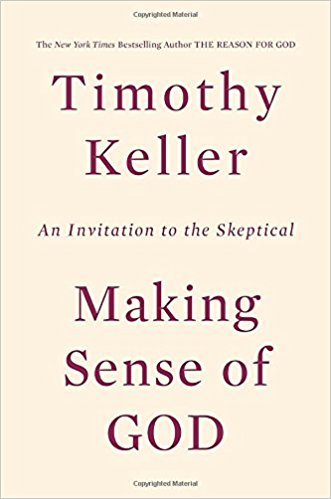
In 2009, Keller wrote the best seller, The Reason for God. In it, he provides a case for belief in God and Christianity. Making Sense of God is a sort of prequel, starting further back in the journey of spiritual exploration as it addresses Christianity's relevance in modern times. Keller also addresses the assumption that the world is getting more secular and the assumptions that many of us wrongly hold about the foundations of what true Christianity is. As always, Keller draws on many philosophical, literary, and cultural sources and lays his argument out in a compelling and easy to read way.

Quotes: “Actually, it is quite natural to human beings to move toward belief in God. As humanities scholar Mark Lilla has written: 'To most humans, curiosity about higher things comes naturally, it’s indifference to them that must be learned.' Strict secularism holds that people are only physical entities without souls, that when loved ones die they simply cease to exist, that sensations of love and beauty are just neurological-chemical events, that there is no right or wrong outside of what we in our minds determine and choose. Those positions are at the very least deeply counterintuitive for nearly all people, and large swaths of humanity will continue to simply reject them as impossible to believe.” 

3. Crossing to Safety by Wallace Stegner (1987)

This was my first Stegner novel, and I highly doubt it will be my last. It was the last novel of this Pulitzer prize winner's life. It is an excellent story about the lives of the Morgans and the Langs, two couples spending life together between work in Madison, WI and vacations in Vermont. Nothing overly spectacular happens in the story, but it is captivating nonetheless. It's mostly about friendship, marriage, and caring for one another, both in the day to day and in the face of terminal illness. 

Quote: “You can plan all you want to. You can lie in your morning bed and fill whole notebooks with schemes and intentions. But within a single afternoon, within hours or minutes, everything you plan and everything you have fought to make yourself can be undone as a slug is undone when salt is poured on him. And right up to the moment when you find yourself dissolving into foam you can still believe you are doing fine.” 

4. David Copperfield by Charles Dickens (1850)

I almost didn't finish this book. After slowly making my way up to the halfway point, I looked at the remaining 400 pages and considering calling it quits. However, my wife convinced me to continue, so I did. And it was worth it. Though I think the story takes a little while to develop and the older English language can be tiring at times, by the end of the book, you have a great cast of characters that I found quite intriguing. This book (mild spoilers ahead) is about a boy who gets orphaned early in life, sent to boarding school by his abusive step-dad, and spends the rest of the story wandering around England, developing rich friendships. David makes a lot of mistakes throughout the novel, trusting those who would take advantage of him and falling in love with the wrong girl, but ultimately, he does develop into a wise man and finally awakens to the reality of Agnes as his true love.

Quote: 'Whenever I have not had you, Agnes, to advise and approve in the beginning, I have seemed to go wild, and to get into all sorts of difficulty. When I have come to you, at last (as I have always done), I have come to peace and happiness. I come home, now, like a tired traveller, and find such a blessed sense of rest!' I felt so deeply what I said, it affected me so sincerely, that my voice failed, and I covered my face with my hand, and broke into tears. I write the truth. Whatever contradictions and inconsistencies there were within me, as there are within so many of us; whatever might have been so different, and so much better; whatever I had done, in which I had perversely wandered away from the voice of my own heart; I knew nothing of. I only knew that I was fervently in earnest, when I felt the rest and peace of having Agnes near me.


This review by Tim Keller first got me interested in this book: "Not only is Ross Douthat's account of orthodox Christianity's decline provocative, but his critique of today's ascendant heresies is compelling. This volume is a sustained proof of Chesterton's thesis that when people turn from God, 'they don't believe in nothing--they believe in anything.' Everyone who is interested in why the church is faring as it is in U.S. culture today needs to get this book." It's definitely an interesting look at the history and current state of pseudo-Christianity movements in this country. 

Quote: “America’s problem isn’t too much religion, or too little of it. It’s bad religion: the slow-motion collapse of traditional Christianity and the rise of a variety of destructive pseudo-Christianities in its place.”

6. In the Garden of the Beasts: Love, Terror, and an American Family in Hitler's Berlin by Erik Larson (2012)

This was my third book by Larson (Others = Dead Wake & Devil in the White City), and though it was my third favorite, it was still quite engaging. Larson centers this work of historical fiction on the U.S. ambassador to Germany (William Dodd) during the mid 1930s and his family. He shows how the horrific thoughts and practices of the Nazis slowly took over the country, in a way that many seemed unaffected by the atrocities going on around them. Dodd tried to be a voice of reason among the madness.

Quote: Throughout that first year in Germany, Dodd had been struck again and again by the strange indifference to atrocity that had settled over the nation, the willingness of the populace and of the moderate elements in the government to accept each new oppressive decree, each new act of violence, without protest. It was as if he had entered the dark forest of a fairy tale where all the rules of right and wrong were upended. He wrote to his friend Roper, “I could not have imagined the outbreak against the Jews when everybody was suffering, one way or another, from declining commerce. Nor could one have imagined that such a terroristic performance as that of June 30* would have been permitted in modern times.”

*June 30, 1934 - The Night of the Long Knives

7. The Ways of White Folks by Langston Hughes (1934)

This is a collection of short stories that mostly looks at the racism and dynamics of race relations in the early 20th century.

Quote: "Bow down and pray in fear and trembling, go way back in the dark afraid; or work harder and harder; or stumble and learn; or raise up your fist and strike-but once the idea comes into your head you’ll never be the same again. Oh, test tube of life! Crucible of the South, find the right powder and you’ll never be the same again-the cotton will blaze and the cabins will burn and the chains will be broken and men, all of a sudden, will shakes hands, black men and white men, like steel meeting steel!” 

Stats: 10 books (3,562 pages) read

Lists from past years:

2016
2015
2014
2013
2012
2011
2010

Sunday, February 26, 2017

Favorite Films of 2016

I like using the Oscars as an excuse to post these later than the end of the year. It definitely helps me get a few more in. A couple of notes: 1) It was very difficult to choose between Moonlight and Manchester by the Sea for the top spot, as both were so very good, 2) O.J. Made in America is one of my favorite documentaries I've ever seen.

Favorite Movies:

1. Moonlight
2. Manchester by the Sea

3. Hell or High Water
4. Rogue One
5. Arrival
6. La La Land

7. Last Days in the Desert
8. Hail, Caesar!
9. Everybody Wants Some
10. Deadpool
11. 10 Cloverfield Lane
12. Zootopia
13. Love and Friendship

Not Yet Seen: Silence, Voyage of Time, Hacksaw Ridge, Loving, Fences, Lion, Hidden Figures

Favorite Documentaries:

1. O.J. Made in America
2. Oasis: Supersonic

Not Yet Seen: 13th, Weiner