Tuesday, July 12, 2011

How Using Smartphones Can Consume Us

A recent Chicago Tribune article looks at the problem of people constantly using smartphones while in a theater. It explains how most people do it without really understanding that it's a distraction for others. Commenting on people texting and tweeting during his shows, comedian Bill Burr wittingly remarked, "half the world is acting as if they're documenting events for a magazine they're not working for."

Here are a couple of interesting paragraphs that talk about the chemical reaction going on in our brains and its effects:
"There are studies about the craving we have for new information. It's pretty clear that when we get a new little piece of information, our brains release some dopamine — which is the neurotransmitter chemical that is how the brain encourages us to do things; it's also the chemical implicated in most addictions. And as you get rewarded by that kind of pleasure of getting a new piece of information, you want to repeat that. … There is something very deep and very primitive in our minds that wants us to gather every little bit of information around us."

(...)

Reached by phone, Greenfield explained the potential downside of all that dopamine. "You're on constant high alert, your adrenaline is rushing because you're clicking and you're texting and as soon as you respond a new thing flashes up. In terms of human beings up until now, this is an unusually fast-paced interactive activity. And we know that dopamine dampens an important frontal part of the brain called the prefrontal cortex," which can cause people to behave more recklessly and with less empathy toward others, she said.

"What our mobile screens seem to encourage is going into a mode that is a rather early stage for the human brain — it's one that small children are in, which has a strong sensory focus and it's very exciting and arousing. This is very different from adult human cognition normally."

But both Greenfield and Zecker point to psychological factors relating to self-worth. Or as Greenfield put it: "One can point to things like Twitter and wonder why people say, 'Look at me doing this' and so on. It reminds me of a small child: 'Look at me, mummy.' Because if you don't look at me and give me feedback, I won't exist."
Something to think about as we should all be considering how to limit the amount of distractions in our lives and also not be consumed with telling the world where we are and what we are doing.

I also thought Nicholas Carr's (author of The Shallows: What the Internet is Doing to our Brains) final remark of the article was spot-on:""We have trained ourselves to multitask even when we're relaxing."

(via)

Tuesday, June 21, 2011

Francis Chan on hell and how to have conversations about it

With all of the recent discussions about hell, Francis Chan talks about his own struggle to find truth here. Apparently, his new book, Erasing Hell, will be coming out in a couple of weeks to discuss this issue.

The video below is a sort of promo for the book and is well worth watching. I love his humility. He talks about wanting to give people truth and not wanting to lead people astray with bad theology. But he also knows that, in many ways, God is a mystery whose thoughts and ways are much higher than and beyond ours, so we can't always know or understand everything. He also talks about how we can sometimes carelessly and heartlessly discuss theological issues, and forget we are dealing with real people.

Check it out:

Sunday, June 12, 2011

A Critique of Bell's Love Wins

I know I'm a little late to the game in reading the book and posting my thoughts. The firestorm that this book created a couple of months ago seems to have died down a little bit.

I thought about posting my thoughts during all the hoopla back in March and April. I had read a few reviews of the book and seen a couple of interviews Rob Bell did, and felt like I should respond like every other Christian seemed to be doing. I'm glad I waited. For one, now I've actually read the book and can comment on the primary source. I also think my thoughts now are much less emotionally charged then they would have been.

I'm not going to give a thorough review. If you want that, Kevin DeYoung has a good (but lengthy) review here. Here are a few of my thoughts:
  1. Bell presents God as only loving. There was no talk of God's holiness or justice.
  2. He makes a caricature of God's anger, completely dismissing the biblical idea of God's anger towards sin.
  3. He suggests (though never explicitly) that all people will eventually spend all eternity with God in heaven. This goes against biblical teaching and the understanding of salvation throughout the entire history of the church.
  4. The one positive aspect of the book is how Bell points out that God is more loving that we tend to believe, and there is a wideness in God's mercy that we should be excited about.
Ultimately, I believe this book will do more harm than good. It moves away from a God-centered view of reality to a more man-centered perspective. It makes our sin of rejecting God on a daily basis to look like it's no big deal. And finally, it seems to move away from sound doctrine to teaching that itching ears want to hear (2 Tim. 4:3).

By the way, here's the The Love Wins trailer that started all the commotion back in February. And here's Bell's interview with Martin Bashir that is really interesting.


Friday, June 10, 2011

Letting the Clean Breeze of the Centuries Blow Through Our Minds

I recently started reading On the Incarnation by Saint Athanasius. It was written about 1700 years ago (in 319). Appropriately, C.S. Lewis writes the brilliant introduction and gives fantastic advice about reading older books. Many of you have probably heard bits of this quote before, but I wanted to share it again its fuller context. I have joyfully lived by this philosophy ever since I first heard it (I've actually started having the opposite problem -- not reading many new books). I hope it will encourage you in the same way:
There is a strange idea abroad that in every subject the ancient books should be read only the professionals, and that the amateur should content himself with the modern books. Thus I have found as a tutor in English Literature that if the average student wants to find out something about Platonism, the very last thing he thinks of doing is to take a translation of Plato off the library shelf and read the Symposium...The student is half afraid to meet one of the great philosophers face to face. He feels himself inadequate and thinks he will not understand him...It has always been one of my main endeavours as a teacher to persuade the young that firsthand knowledge is not only more worth acquiring than secondhand knowledge, but is usually much easier and more delightful to acquire.

(...)

...Naturally, since I myself am a writer, I do not wish the ordinary reader to read no modern books. But if he must read only the new or only the old, I would advise him to read the old...A new book is still on its trial and the amateur is not in a position to judge it. It has to be tested against the great body of Christian thought down the ages, and all its hidden implications (often unsuspected by the author himself) have to be brought to light...It is a good rule, after reading a new book, never allow yourself another new one till you have read an old one in between. If that is too much for you, you should at least read one old one to every three new ones.

Every age has its own outlook. It is specially good at seeing certain truths and specially liable to make certain mistakes. We all, therefore, need the books that will correct the characteristic mistakes of our own period. And that means the old books..Where [modern books] are true they will give us truths which we half knew already. Where they are false they will aggravate the error with which we are already dangerously ill. The only palliative is to keep the clean sea breeze of the centuries blowing through our minds, and this can be done only by reading old books. Not, of course, that there is any magic about the past. People were no cleverer then than they are now; they made as many mistakes as we. But not the same mistakes. They will not flatter us in the errors we are already committing; and their own errors, being now open and palpable, will not endanger us. Two heads are better than one, not because either is infallible, but because they are unlikely to go wrong in the same direction. To be sure, the books of the future would be just as good a corrective as the books of the past, but unfortunately we cannot get at them.

Tuesday, May 31, 2011

The Tree of Life

Last Friday, Brittany and I went to see The Tree of Life in Hollywood. I've been anticipating this movie for a quite a while. It is the mysterious director Terrence Malick's fifth film in almost forty years. His other movies include Badlands (1973), Days of Heaven (1978), The Thin Red Line (1998), and The New World (2005).

Aesthetically, The Tree of Life is the most beautiful film I've ever seen. Malick uses unique camera angles and gorgeous, natural imagery to create a true work of art. And I'm not quite sure what his worldview is, but it is easy tell that he is very influenced by Christian themes.

Before you go see the movie, you should be aware of some things. It might feel slow at times. There is a break in the middle that shows what creation might have looked like. And there are dinosaurs... briefly. Brett McCracken gives some helpful pointers on how to watch it. The most helpful for me was to "let it roll over you." As you're watching don't focus on trying to "figure it out." Just receive it as is. I think you will find that you will enjoy the experience.

Also, here's the end of Paste's review that summarizes the basic idea of the movie:
...between shots of bubbling lava, there’s a family that you come to care deeply about, including the very flawed patriarch. The themes are grand and punctuated by a sermon on Job in the middle: Why do bad things happen to good people? What’s the value of selflessness? Do the sins of the father need to be revisited by the son? Malick touches on creation and evolution, the existence of heaven and the purpose of life, but does so as much through the humble world of Waco, Texas, in summertime, as through the direct questions from a boy to his Creator that transition between epochs. It’s as much a meditation as a narrative, asking a tremendous amount of patience from viewers and rewarding that patience with something entirely new.
This trailer should whet your appetite:

Saturday, May 21, 2011

How to respond when the rapture doesn't happen

Justin Taylor pointed out some wise and convicting words from Eric Landry. He encourages us to not mock those who thought the rapture was coming today, but to be ready to love on them. I am reminded that nothing I believe is apart from God's grace, so I have no reason to boast, or laugh at others for believing differently than me. Here's what Eric said:
We must be very careful about how we respond. Will we join our friends at the “Rapture Parties” that are planned for pubs and living rooms around the nation? Will we laugh at those who have spent the last several months of their lives dedicated to a true but untimely belief? What will we say on Saturday night or Sunday morning?

History teaches us that previous generations caught up in eschatological fervor often fell away from Christ when their deeply held beliefs about the end of the world didn’t pan out. While Camping must answer for his false teaching at the end of the age, Reformational Christians are facing a pastoral problem come Sunday morning: how can we apply the salve of the Gospel to the wounded sheep who will be wandering aimlessly, having discovered that what they thought was true (so true they were willing to upend their lives over it) was not? If this isn’t true, they might reason, then what other deeply held beliefs and convictions and doctrines and hopes might not be true?

It’s at this point that we need to be ready to provide a reasonable defense of our reasonable faith. Christianity is not founded upon some complex Bible code that needs years of analysis to reveal its secret. Christianity is about a man who claimed to be God, who died in full public view as a criminal, and was inexplicably raised from the dead three days later appearing to a multitude of witnesses. When his followers, who witnessed his resurrection, began speaking of it publicly, they connected the prophecies of the Old Testament to the life and death and resurrection of this man who claimed the power to forgive sins. This is the heart of the Christian faith, the message that deserves to be featured on billboards, sides of buses, and pamphlets all over the world. It is also the message that needs to be reinvested into the hearts and lives of those who found hope and meaning in Harold Camping’s latest bad idea.

Wednesday, May 18, 2011

Funny interview by an honest Florida football player

Abraham Piper pointed out a hilarious interview on his blog. It's between a Gator County reporter and Ja'Jaun Story, an incoming wide receiver soon to play at Florida. His honesty is pretty amazing and ends up saying some pretty funny stuff. For instance:
Q: What’s your most embarrassing moment on the field?
A: I was running, I was gonna score a touchdown and then some kid came behind me and grabbed my pants down, and my pants came down, so it was pretty embarrassing. I think I turned red a little bit. My booty was out, it was pretty embarrassing.
Q: If you were a character from a Disney movie, who would you be and why?
A: Aladdin, I think he’s pretty cool, he’s like easy going, cool guy, and he has Jasmine. I like how he wears his little vest with it open.
And here's the best part:
Q: What’s the most played song on your iPod?
A: Most played…I don’t know, I want to say Katy Perry, “Fireworks.” It’s intense.
Q: What’s your favorite pre-game ritual?
A: Well, I take a doodoo. Before every game I doodoo.
Q: That’s your FAVORITE pregame ritual?
A: Well, that’s the only thing I do. That’s one thing I have to do before every game, or I won’t feel energy, and I’ll just feel slow. When I do I just feel light on my feet and everything, and I feel faster, so that’s what I do.
Q: You know I’m going to write this in a story right?
A: Well, I mean, that’s what it is. I doodoo and then listen to Katy Perry.
I feel like this is a type of guy I'd love to hang out with. Click here to read the whole interview.

Sunday, May 15, 2011

Depression in different cultures

Ed Welch has another interesting article on the CCEF blog, this time about depression. He notes that depression looks different in all parts of the world. He points out that the following are all different ways of describing depression:
A Nigerian who describes a peppery feeling in his head
A Chinese farmer who complains of shoulder and stomach aches
A Korean woman who speaks of burning in her stomach
An Iranian who identifies tightness in his chest
An American who feels interminably sad
He goes on to talk about how you interpret depression (or any pain) differently. Great perspective:
Here is one conclusion from this type of research: depression is not simply a universal pattern of neuronal firing caused by predetermined genetic combinations. At least, it consists of an experience that is shaped by a cultural narrative. Depression has a story overlaid on it. In some cultures the story suggests that the experience is normal and is part of the process of developing character and strength. In others, such as our own, it is a brain pathology that must be treated quickly or it will leave the victim incapacitated.

Your interpretation of pain affects the experience of your pain. If the pain in your chest is from a slightly pulled muscle, you are proud that you are working out. If you believe it is from a tumor or incipient heart failure, it will hurt much worse.

If you experience peculiar sadness, and you are persuaded that God is with you and, through his love, is making you increasingly fruitful, your emotional limp will be less noticeable. But if your hardships are merely neuronal, there is nothing you can do except hope for the right combination of medications.

(...)

We turn to what is universal. We turn to what goes deeper than culture—the God revealed to us by Scripture. One of the beauties of God’s revelation is that we know (1) in this world there will be trouble, and (2) we don’t have to know the cause of the trouble in order to help each other know the comfort of Christ, grow in our confidence in his promises, and fruitfully abide in him. This is for everyone, in every culture.

Wednesday, April 06, 2011

Radiohead therapy

Long time Radiohead fans will appreciate the humor here:

(via)

Monday, March 28, 2011

Getting Settled

I don't do many personal updates on this blog (even though many have lovingly suggested that I do), so I thought now is as good a time as any to do that since I just moved across the country. Just over two weeks ago, I made the drive across the country from Atlanta to Pasadena. Here are some highlights of what has happened since then:

The drive took about thirty hours, spread out over three days. I really loved the experience and enjoyed all the different scenery. I think Arizona might have been my favorite. This picture is either from New Mexico or Arizona, not really sure.
Here are a couple of pics of what Brittany made for me in her apartment. It sure was good to see her!
Here is what my apartment looks like (before I bought any furniture). This is looking from my door, through the kitchen, into the living room. My bedroom is above the kitchen and is accessed by the stairs on the left.
Looking the opposite direction
Here's the living room with furniture. By the way, I packed my car up with some basic things, but the majority of my stuff has still not made it. They were originally supposed to deliver it between March 14 and 18. As of today the window is March 30 thru April 3. Seriously, don't use US-1 Van Lines.
The view from my living room. Part of Fuller's campus can be seen on the left.
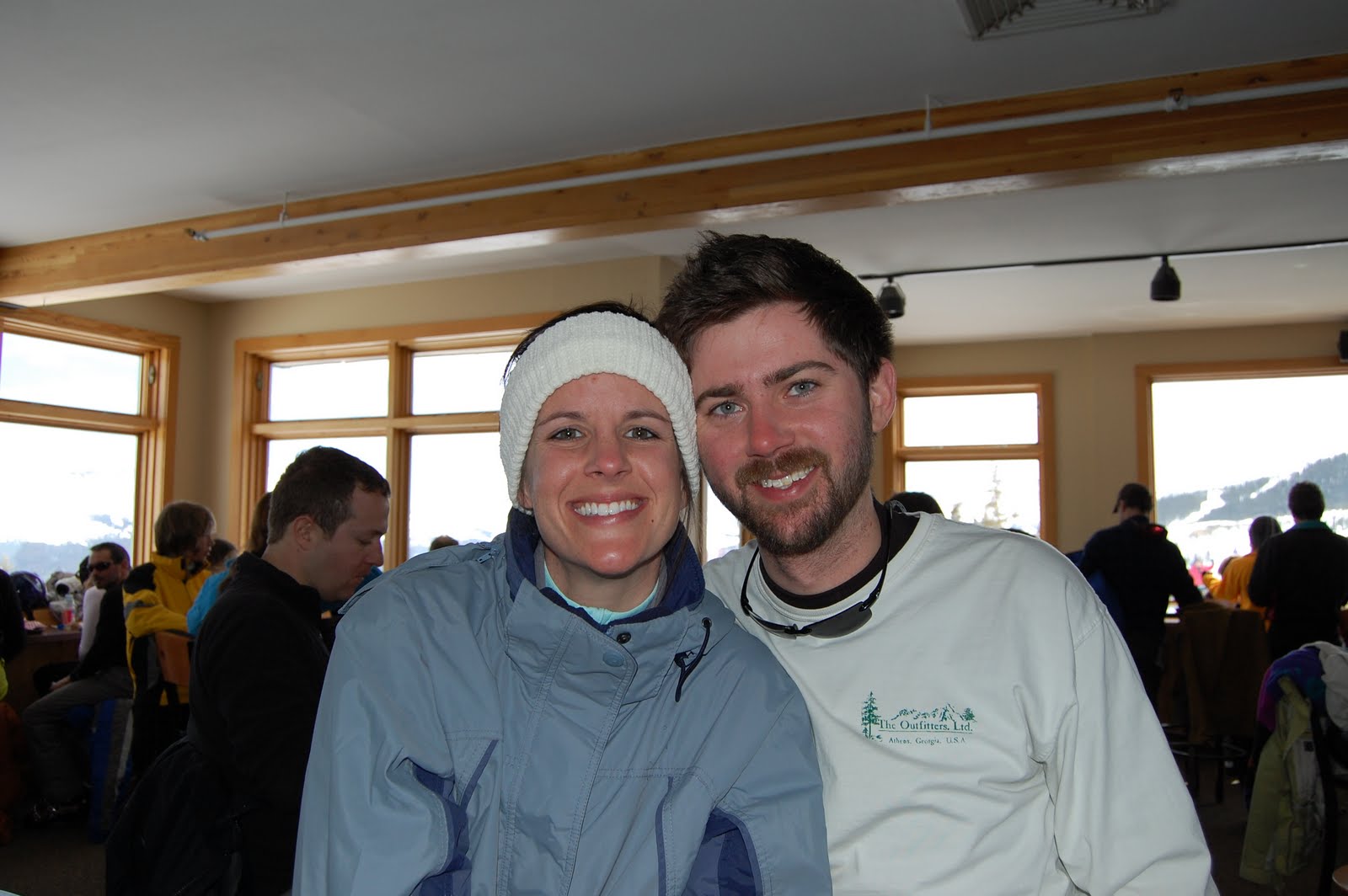
Oh yeah, Brittany and I met my family in Breckenridge to do a little skiing last weekend.

Classes started today and I'm excited to be taking courses on the Pentateuch, Church History, and Christology/Pneumatology/Soteriology. Thanks to all of you who have been praying for me and keeping in touch. Though I am enjoying it here, I've been realizing more and more what a great community I left behind. Those of you in that community, you are greatly missed.

Wednesday, March 16, 2011

Being afraid of being alone

Francis Schaeffer:
“People today are afraid to be alone. This fear is a dominant mark of our society. Many now ceaselessly sit in the cinema or read novels about other people’s lives or watch dramas. Why? Simply to avoid having to face their own existence. . . .

No one seems to want (and no one can find) a place of quiet — because, when you are quiet, you have to face reality. But many in the present generation dare not do this because on their own basis reality leads them to meaninglessness; so they fill their lives with entertainment, even if it is only noise. . . .

The Christian is supposed to be very opposite: There is a place for proper entertainment, but we are not to be caught up in ceaseless motion which prevents us from ever being quiet. Rather we are to put everything second so we can be alive to the voice of God and allow it to speak to us and confront us.”
(via)

Monday, February 28, 2011

Dancing Thom

One of my favorite bands, Radiohead, came out with their eighth studio album a two Fridays ago called The King of Limbs. There is a video out for one of the tracks, Lotus Flower. It's basically just Thom Yorke (the lead singer) dancing in way that some might call weird but I call amazing! Check it out:


In honor of his moves, a site was recently launched called Dancing Thom. People are basically mashing up the above video with other random songs. It's definitely worth checking out. Here's my favorite so far:


You can also check out Paste's favorites here.

Wednesday, February 23, 2011

Encounter with Aslan: The Dawn Treader

My favorite Aslan encounter in the Narnia series comes from The Voyage of the Dawn Treader. Eustace, who had been turned into a dragon, is explaining to Edmund how he got turned back into a boy:
"Well, anyway, I looked up and saw the very last thing I expected: a huge lion coming slowly toward me. And one queer thing was that there was no moon last night, but there was moonlight where the lion was. So it came nearer and nearer. I was terribly afraid of it. You may think that, being a dragon, I could have knocked any lion out easily enough. But it wasn't that kind of fear. I wasn't afraid of it eating me, I was just afraid of it -- if you can understand. Well, it came close up to me and looked straight into my eyes. And I shut my eyes tight. But that wasn't any good because it told me to follow it."

"You mean it spoke?"

"I don't know. Now that you mention it, I don't think it did. But it told me all the same. And I knew I'd have to do what it told me, so I got up and followed it. And it led me a long way into the mountains. And there was always this moonlight over and round the lion wherever we went. So at last we came to the top of a mountain I'd never seen before and on top of this mountain there was a garden -- trees and fruit and everything. In the middle of it there was a well."

"I knew it was a well because you could see the water bubbling up from the bottom of it: but it was a lot bigger than most wells -- like a very big, round bath with marble steps going down into it. The water was as clear as anything and I thought if I could get in there and bathe it would ease the pain in my leg. But the lion told me I must undress first. Mind you, I don't know if he said any words out loud or not."

I was just going to say I couldn't undress because I hadn't any clothes on when I suddenly thought that dragons are snaky sort of things and snakes can cast their skins. Oh, of course, thought I, that is what the lion means. So I started scratching myself and my scales started coming off all over the place. And then I scratched a little deeper and, instead of just scales coming off here and there, my whole skin started peeling off beautifully, like it deals after an illness, or if I was a banana. In a minute of two I just stepped out of it. I could see it lying there beside me, looking rather nasty. It was a most lovely feeling. So I started to go down to the well for my bathe."

"But just as I was going to put my feet into the water I looked down and saw that they were all hard and rough and wrinkled and scaly as they had been before. Oh, that's all right, said I, it only means I had another smaller suit on underneath the first one, and I'll have to get out of it too. So I scratched and tore again and this underskin tore off beautifully and out I stepped and left it lying beside the other one and went down to the well for my bathe."

"Well, exactly the same thing happened again. And I thought to myself, oh dear, how ever many skins have I got to take off? For I was longing to bathe my leg. So I scratched away for the third time, just like the two others, and stepped out of it. But as soon as I had looked at myself in the water I knew that it had been no good."

"Then the lion said -- but I don't know if it spoke -- 'You will have to let me undress you.' I was afraid of his claws, I can tell you, but I was pretty nearly desperate now. So I just lay flat down on my back and let him do it."

The very first tear he made was so deep that I thought it had gone right into my heart. And when he began pulling the skin off, it hurt worse than anything I’ve ever felt. The only thing that made me able to bear it was just the pleasure of feeling the stuff peel off. You know – if you’ve ever picked the scab off a sore place. It hurts like billy-oh but it is fun to see it coming away."

"I know exactly what you mean," said Edmund.

"Well, he peeled the beastly stuff right off – just as I thought I’d done myself the other three times, only they hadn’t hurt – and there it was lying on the grass: only ever so much thicker, and darker, and more knobbly looking than the others had been. And there was I as smooth and soft as a peeled switch and smaller than I had been. Then he caught hold of me – I didn’t like that much for I was very tender underneath now that I had no skin on – and threw me into the water. It smarted like anything but only for a moment. After that it became perfectly delicious and as soon as I started swimming and splashing I found that all the pain had gone from my arm. And then I saw why. I’d turned into a boy again. You'd think me simply phony if I told you how I felt about my own arms. I know they've no muscle and are pretty mouldy compared with Caspian's, but I was so glad to see them."

"After a bit the lion took me out and dressed me -- "

"Dressed you? With his paws?"

"Well, I don't exactly remember that bit. But he did somehow or other: in new clothes – the same I’ve got on now, as a matter of fact. And then suddenly I was back here. Which is what makes me think that it must have been a dream."

"No, it wasn't a dream," said Edmund.

"Why not?"

"Well, there are the clothes, for one thing. And you have been -- well, un-dragoned, for another."

"What do you think it was then?" asked Eustace.

"I think you've seen Aslan", said Edmund.

Tuesday, February 22, 2011

Tim Keller on MSNBC

It's refreshing to hear a Christian leader graciously and winsomely talk about the truth of Christianity in a TV interview. Keller does so here

Visit msnbc.com for breaking news, world news, and news about the economy

Monday, February 21, 2011

Encounter with Aslan: The Silver Chair

I've been reading through The Chronicles of Narnia recently, since I received them for Christmas. It is my very first time through and I am loving them. It's opened up a new world of C.S. Lewis for me, as this is the first of his fiction that I've read. Not surprisingly, I love his way with words and his imagination.

My favorite moments of the books have been the encounters with Aslan. I finished The Silver Chair last night and wanted to share my favorite part of the book. It is a conversation between Jill, as she first meets Aslan:
“If you are thirsty, you may drink.”

They were the first words she had heard since Scrubb had spoken to her on the edge of the cliff. For a second she stared here and there, wondering who had spoken. Then the voice said again, “If you are thirsty, come and drink,” and of course she remembered what Scrubb had said about animals talking in that other world, and realized that it was the lion speaking. Anyway, she had seen its lips move this time,and the voice was not like a man’s. It was deeper, wilder, and stronger; a sort of heavy, golden voice. It did not make her any less frightened than she had been before, but it made her frightened in rather a different way.

“Are you not thirsty?” said the lion.

“I’m dying of thirst,” said Jill.

“Then drink,” said the lion.

“May I – could I – would you mind going away while I do?” said Jill.

The Lion answered this only by a look and a very low growl. And as Jill gazed at its motionless bulk, she realized that she might as well have asked the whole mountain to move aside for her convenience.

The delicious rippling noise of the stream was driving her nearly frantic.

“Will you promise not to – do anything to me, if I do come?” said Jill.

“I make no promise,” said the Lion.

Jill was so thirsty now that, without noticing it, she had come a step nearer.

“Do you eat girls?” she said.

“I have swallowed up girls and boys, women and men, kings and emperors, cities and realms,” said the Lion. It didn’t say this as if it were boasting, nor as if it were sorry, nor as if it were angry. It just said it.

“I daren’t come and drink,” said Jill.

“Then you will die of thirst,” said the Lion.

“Oh dear!” said Jill, coming another step nearer. “I suppose I must go and look for another stream then.”

“There is no other stream,” said the Lion.

It never occurred to Jill to disbelieve the Lion – no one who had seen his stern face could do that – and her mind suddenly made itself up. It was the worst thing she had ever had to do, but she went forward to the stream, knelt down, and began scooping up water in her hand. It was the coldest, most refreshing water she had ever tasted. You didn’t need to drink much of it, for it quenched your thirst at once.

Friday, February 18, 2011

An Inside Look At Scientology

My friend Bailey recently told me about an article in The New Yorker entitled The Apostate. It is looking at Scientology, mainly through the experience of screenwriter and film director Paul Haggis. Paul, for a time, was very involved in the "church," as he made it as far up as you can go in their ranks. But in 2009, he began questioning his involvement and has since become an outspoken voice for many of its harmful practices and teachings.

I have some special interest in Scientology because I (along with Bailey and many others) spent three summers in the early 2000s in Clearwater, Florida, a couple miles from its worldwide spiritual headquarters. We would often witness the odd behavior of the members walking around the streets in their strange uniforms. With much intrigue, I began researching to know more about this movement/religion/cult or whatever you want to call it.

It was founded in 1954 by L. Ron Hubbard. Here's a quick overview of the "church" from the article:
The Church of Scientology says that its purpose is to transform individual lives and the world. “A civilization without insanity, without criminals and without war, where the able can prosper and honest beings can have rights, and where man is free to rise to greater heights, are the aims of Scientology,” Hubbard wrote. Scientology postulates that every person is a Thetan—an immortal spiritual being that lives through countless lifetimes. Scientologists believe that Hubbard discovered the fundamental truths of existence, and they revere him as “the source” of the religion.

Hubbard’s writings offer a “technology” of spiritual advancement and self-betterment that provides “the means to attain true spiritual freedom and immortality.” A church publication declares, “Scientology works 100 percent of the time when it is properly applied to a person who sincerely desires to improve his life.” Proof of this efficacy, the church says, can be measured by the accomplishments of its adherents. “As Scientologists in all walks of life will attest, they have enjoyed greater success in their relationships, family life, jobs and professions. They take an active, vital role in life and leading roles in their communities. And participation in Scientology brings to many a broader social consciousness, manifested through meaningful contribution to charitable and social reform activities.”
And here's a good description of their practice of Dianetics:
“Dianetics” purports to identify the source of self-destructive behavior—the “reactive mind,” a kind of data bank that is filled with traumatic memories called “engrams,” and that is the source of nightmares, insecurities, irrational fears, and psychosomatic illnesses. The object of Dianetics is to drain the engrams of their painful, damaging qualities and eliminate the reactive mind, leaving a person “Clear.”
After reading the article, it becomes obvious that Scientology is almost exclusively a religion based on pragmatism rather than truth. No one seems to make any truth claim apart from commending how the beliefs and practices make life work better. But it's ironic that, pragmatically speaking, it seems to fail. People don't seem happier. They seem controlled and much poorer than when they started.

I'd encourage you to read the entire article, because it is quite fascinating. Though I should warn you that it is rather lengthy.

Also, a few years back, I saw a special that the BBC did on Scientology called Panorama: Scientology and Me. The reporter has multiple interactions with Tommy Davis (who you would find from the article is Scientology's main PR guy), and it's crazy to watch how much effort Tommy goes into as he tries to stop the BBC from doing their story. You can watch it in four separate YouTube videos:

Part 1
Part 2
Part 3
Part 4

Thursday, February 10, 2011

The Whole Point of Being a Christian

After referencing this quote by Margaret Durham (1668), Ray Ortlund says this:
"...Personal communion with Christ is real. It is the whole point of being a Christian. It is what the Bible is for. It is our endless future.

...The Puritans, among others, knew a lot about it. They experienced it. They pursued it. Have we graduated to a spiritual level above them, such that we can smile condescendingly? Or is it we who have drifted from the sacred center and need to repent and come back and reengage with our Lord in profound and very, very personal ways?"
This seems to be a simple truth, one that should be very obvious to me. But as I read these words, I have become profoundly convicted.

Somewhere along the way I have preferred to read books about biblical truth than actually read the Bible in order to commune with my heavenly Father. I have become complacent and lazy. More than that, I have become rebellious, preferring entertainment and everything else to fellowship with Him. I repent. Lord help me desire You.

Wednesday, February 02, 2011

Jesus Wants to Meet Us in Our Shame

Over at the CCEF blog, Ed Welch writes about the differences between shame and guilt. He says that guilt is usually black and white. You either did wrong or you didn't. Shame, however, is harder to pinpoint. He says, "With shame, we feel like we did wrong, but we can’t always identify what that wrong was, or we can identify a thousand wrongs, though none of them might be the actual trigger for shame."

He goes on to talk about how shame is not something that is talked a lot about in church or our communities. Because of that, shame is often left unidentified and continues to to plague us. We must seek to identify those things in our lives that have brought shame.

I began this process in my own life a few years back. I knew I struggled with anxiety and nervousness in different social situations but never knew why. I also knew I was an approval junkie, constantly needing others to validate me. God began revealing how I had believed certain lies growing up and had massive amounts of shame associated with this anxiety. Because these lies and the shame have been brought more into the light, God has begun bringing great amounts of freedom in this area, freeing me to let God's love be enough for me.

Back to Ed Welch's post, here are a few key paragraphs that I thought were helpful::
Shame has to do with your standing before God and your standing in the community. You think you should be unaffected by the opinions and words of other people? Not so. We were created to live in community, and anything that jeopardizes our inclusion goes against who we really are.

Worthlessness is an easy place to begin defining shame. Have you ever felt worthless? I am guessing that I am not alone in this one. I feel worthless when I notice student indifference after a lecture, when I preach and know that I was less than helpful, when I become alert to my weaknesses as a counselor and wonder why I am inflicting myself on people, and, of course, I could go on.

Worthlessness evokes images of value. It means that your standing with others has gone way down. You know you are a failure, so does everyone else. Our despair over our worthlessness could reflect our pride. That is, “I feel so bad because I want to be great.” And, no doubt, there is pride mixed in with worthlessness. But Jesus doesn’t go to lepers and talk about their pride. Instead, he touches them as a way to show his fellowship and acceptance, and he restores them to his community, though acceptance into the community of mortals like us is not guaranteed.

Shame. You feel worthless, rejected, dirty and exposed. Sometimes you feel it because of what you have done, in which case your badness must exceed community standards. For example, there are some things that Christians confess in public – a little bit of lust, anxieties about money, not listening to a spouse, erratic quiet times. These are the sins that, when you confess them, everyone is nodding in agreement. But there are other acts that leave everyone else in silence because these sins are less common and less acceptable. Shame attaches itself to these sins. But not only to these sins...

Shame does indeed have many faces. It seems to be everywhere and yet still be elusive. Maybe that’s why you can’t do anything with it until you put words on it. But God puts words on it, so we should too. That itself can be hopeful. It can also leave us wanting more. If you want more right away, just watch Jesus. He goes out of his way to meet, touch, bless, and restore the shamed:
  • a Samaritan woman who is not measuring up to community standards
  • a woman who sexual past identified her as a “sinful woman”
  • lepers
  • tax collectors
  • a woman whose bleeding renders her unclean
  • a disciple who denied any association with him
The Gospel of Jesus is “I am yours and you are mine, and I’m not letting you get away.”